
What Is a Chaser Bin and How Does It Work?
A chaser bin keeps your header cutting instead of stopping to unload. Here's what it is, how it works, and an honest look at whether you actually need one.
What Is a Chaser Bin and How Does It Work?
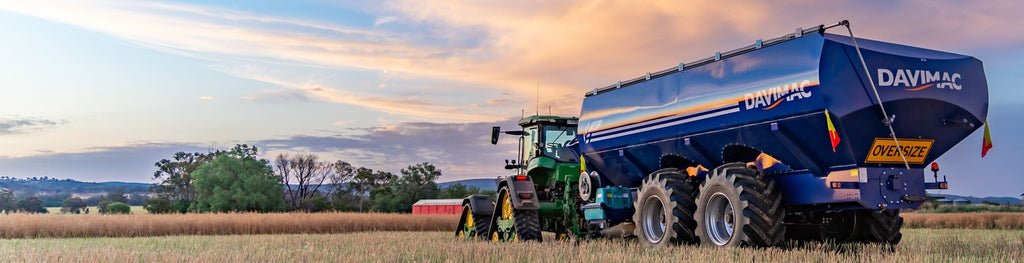
A chaser bin is a tractor-towed trailer with a built-in auger system that collects grain from a harvester on the move, so the 'header' (aka: combine harvester) never has to stop moving to unload. A chaser bin may also be known as a grain cart, haulout bin, or grain auger wagon in some markets.
Already know what a chaser bin is?
View Davimac's 25-45T chaser bin range →
Australian made in Central West NSW and engineered specifically for Australian paddock conditions, our chaser bins are available in single-axle and dual-axle configurations from 25T to 45T with an impressive list of standard features and large range of options.

Here's how they work, why they exist, what they can cost you if you don't have one, and how to think about whether one suits your operation.
In this guide:
- What is a chaser bin?
- How does a chaser bin work?
- Why chaser bins exist: the harvest logistics problem
- Where chaser bins came from
- What are the benefits of a chaser bin?
- Chaser bin sizes and capacity
- Single axle vs dual axle
- Chaser bin vs mother bin vs field bin
- Do you actually need one?
- Chaser bin safety basics
- Quick answers
What is a chaser bin?
A chaser bin is a large-capacity trailer, ranging from around 25 to 45 tonnes in the Australian market, fitted with a horizontal cross auger and a vertical discharge auger. It's generally towed by a dedicated tractor and 'chases' the header during harvest, taking grain directly from the header's unload spout while both machines are moving, and carries that grain to a waiting truck, mother bin, or on farm storage. The name varies by region and generation: in Australia you'll hear chaser bin and, less commonly, haulout bin; in North America the standard term is grain cart, and older literature sometimes uses bank-out wagon, or grain auger wagon.

Chaser bins are distinct from a grain trailer. A chaser bin loads and unloads grain mechanically through the screw inside the discharge auger rather than by tipping, which is what allows it to receive grain on the move and discharge it at height into a truck or mother bin. A tipping grain trailer can carry grain and receive it from the combine harvester, but has to tip it inside a temporary storage shed (common in British or European farms), and it can't lift it several metres directly into a waiting truck, which is a requirement in many large farming operations.
How does a chaser bin work?
The mechanics are straightforward, even though the operating skill takes a season to properly learn. Grain enters the bin from the header's unload auger and lands in the hopper, where a horizontal cross auger (typically 16 to 20 inches in diameter) feeds it toward the front of the bin. From there, a vertical discharge auger (20 to 24 inches, depending on model) lifts the grain and delivers it through a hydraulically adjustable spout, either into a truck, a mother bin, or a field bin.

Drive comes from the tractor, either through a PTO shaft at a standard 1,000 rpm or, on some machines, an optional hydraulic drive motor for tractors without PTO. A tarp covers the load in transit, cleanout doors underneath let the bin be fully emptied and cleaned between crops, and a swivelling or ball-and-pin hitch connects it to the tractor's drawbar. Larger models add features like load cell scales, cameras, work lights and, on some tandem-axle bins, a self-steering rear axle to reduce scrubbing on tight turns.
A detail that matters more than it looks like it should: auger flight thickness and balance. A vertical auger unloading at up to a tonne every few seconds is under constant load, and thin flights bow over time, which throws the auger out of balance and shows up as vibration, uneven wear and a shortened working life. It's one of the few genuine engineering differences between a well-built chaser bin and a lightly built one, and it's rarely visible from a brochure photo.

The undercarriage does a similar amount of quiet work. On tandem-axle bins, a floating walking beam lets both axles rock independently over uneven ground, keeping all four tyres loaded and in contact with the surface rather than letting weight spike through one pair as the bin rocks. That's a different design philosophy to axles adapted from road trailers, which typically use leaf springs, shackles and bushes, components that wear under the shock loading and side forces a paddock puts through them in a way a highway trailer never experiences.
Why chaser bins exist: the harvest logistics problem
Chaser bins solve a specific bottleneck: a harvester that has to stop and wait to unload is a harvester that isn't cutting. That sounds like a minor inconvenience until you look at what it actually costs across a harvest. Combine harvesters can spend a substantial share of harvest time unloading or travelling to a fixed bin rather than cutting, and delayed harvest carries a real yield cost: GRDC's harvest loss guidance, drawing on international agricultural engineering standards, treats total harvest losses above around 1% of yield as the threshold worth actively managing, and timing is one of the biggest levers growers have over that number.
The scale of the industry is what makes small efficiency gains compound. ABARES' June 2026 Australian Crop Report forecasts national winter crop production at 54.5 million tonnes for the 2026-27 season, still the seventh-highest winter crop on record despite being down on the prior year. At that volume, a harvest logistics system that keeps headers cutting rather than idling translates directly into tonnes captured in good condition rather than degraded by a shrinking weather window.

A chaser bin doesn't change how fast the header cuts. It changes what happens the moment the header's tank is full: instead of the header stopping and waiting for a truck to arrive across the paddock, the chaser bin is already alongside, ready to take the load without either machine breaking stride.
Where chaser bins came from
Chaser bins emerged in North America as combine harvesters grew larger and grain tanks began outrunning the practical limits of stopping to unload every few minutes. As header capacity climbed through the latter half of the twentieth century, using a towed cart to receive grain on the move became the obvious answer, and the machine spread under the name grain cart, still the standard term in the United States and Canada today.
Australian broadacre farming adopted the same solution under a different name, chaser bin, as local header capacity and paddock sizes grew through the 1980s and 1990s. The core design converged everywhere for the same reason: a cross auger feeding a vertical discharge auger is simply the most reliable way to move grain out of a bin quickly without additional machinery.

Photo: Original Davimac chaser bin, Molong circa 1983
Local manufacturing then diverged on undercarriage design, build specification and options, walking beam axles, flotation tyres and scales among them, refined for Australian soils, distances and harvest conditions rather than the flatter, more uniform country typical of the North American grain belt.
What are the benefits of a chaser bin?
The advantages compound across a harvest rather than showing up as one single saving:
-
Continuous header operation. The header keeps cutting instead of stopping to unload into a truck or a fixed field bin, which is the core of the time saving. Over a full harvest, the cumulative minutes add up to real hours, and those hours matter most exactly when weather is closing a window.

- Fewer truck movements across the paddock. Trucks load from the chaser bin (or a mother bin the chaser feeds) at the paddock edge or a firm access point, rather than driving onto soft ground repeatedly. That also keeps trucks on their most productive job, the road leg, rather than idling in a paddock.
- Reduced soil compaction. Keeping heavy trucks off the paddock, combined with wider or flotation tyres on the chaser bin itself and an undercarriage that spreads load across multiple axles, reduces the compaction that costs potential yield in future seasons. Controlled traffic farming systems build on this further by confining wheel tracks, chaser bin included, to permanent tramlines; we cover tyre and track choice in more depth in tracks vs tyres on chaser bins.
- Better grain quality. Fewer handling points and a well-designed auger system mean less grain damage between header and storage than repeated tipping and reloading, particularly for crops sensitive to cracking or splitting.
- Captures more of a narrow weather window. When rain is closing in, the difference between a header that keeps moving and one that's queued behind trucks can be the difference between harvesting a paddock in good condition and watching quality slip while it waits.
- Data, if it's fitted with scales. Load cells turn every load into a recorded weight, useful for both truck compliance (loading to an accurate, known figure rather than an estimate) and paddock-level yield records independent of the header's own yield monitor.

Chaser bins have to work harder or faster than the header, as it is common for one chaser bin to service up to 3 headers.
Chaser bin sizes and capacity
Australian chaser bins typically range from 25 to 45 tonnes of wheat capacity, though the actual volume (usually 31 to 60 cubic metres) is the more reliable figure to compare across brands, since tonnage ratings assume a specific crop density and a bin never carries its rated tonnage in a lighter commodity like canola.
As a rule of thumb, a chaser bin should hold at least two full header tank fills, ideally three, so the header can run several cycles before the bin needs to unload. The right size depends on header class, truck or mother bin availability, and paddock-to-truck distance.
Single axle vs dual axle
Smaller chaser bins (typically 25 to 30 tonnes) run on a single axle, which is lighter, simpler and cheaper. Larger bins (30 tonnes and up) generally run on a tandem axle with a walking beam undercarriage, spreading the load across four tyres for better flotation and a smoother ride on rough or wet ground. Some very large models add a third axle again. The right configuration depends more on soil type and paddock conditions than on capacity alone.
Chaser bin vs mother bin vs field bin
These three terms get used loosely and interchangeably, which causes real confusion, but each serve different purposes.
- A chaser bin (25 to 45 tonnes) follows the header in the paddock and keeps it cutting.
- A mother bin (typically 100 to 150 tonnes) is a much larger, less mobile transfer bin that sits at the paddock edge; chaser bins unload into it, and trucks load out of it, which decouples the harvesting side of the operation from the trucking side.
- A field bin is on-farm storage, generally moved empty and left in place to hold grain until it's convenient to cart, used for buffering against receival site queues or for segregating grades.

Do you actually need one?
The honest answer depends on where your current bottleneck actually sits, not on whether chaser bins are generally a good idea. If your header already waits on trucks regularly, if your paddocks are large enough that travel time to a fixed bin eats real hours, or if you're running more than one header, a chaser bin addresses a genuine, measurable cost.
If your acreage is small enough that the header rarely finishes a tank before the truck's back, or your paddock-to-storage distance is short, the case is weaker, and the money might do more for you elsewhere, extra truck capacity, for instance, or a bigger header.
The maths
The way to check is to time your current system for a day: add up how long the header actually sits idle waiting to unload. If it's a handful of minutes a day, a chaser bin is solving a small problem. If it's regularly costing an hour or more, the arithmetic tends to favour one quickly, particularly across a full harvest and multiple seasons. If that arithmetic points toward buying, our chaser bin buyer's guide works through capacity, axles, auger, build quality and every other decision in detail.
Chaser bin safety basics
Three things account for most chaser bin incidents: the auger, the loaded weight, and the hitching process. The auger must never be approached or entered while it has power, the loaded bin tows and brakes very differently from empty (Australian operator manuals typically specify a maximum of 10 km/h loaded), and hitching requires nobody standing between the machines while they're moving. These aren't chaser bin-specific quirks, they're the same categories of hazard as any large towed agricultural implement, but the auger in particular deserves specific respect given how quickly it moves grain. A full rundown of the rules, the reasoning behind them, and an induction-ready checklist is in our chaser bin safety guide.

A water tank and pump kit fitted to chaser bin improve harvest fire safety.
Davimac Knowledgebase
Whatever stage you're at, whether you're comparing the range of chaser bins available or just getting familiar with the category, the rest of this knowledgebase works through each decision in more depth than fits in an overview.
Quick answers
What is a chaser bin used for?
A chaser bin collects grain from a harvester while both machines are moving, so the header never has to stop and wait to unload. It temporarily stores the grain, then transfers it to a truck, a mother bin, or on-farm storage using its own auger system.
Is a chaser bin the same as a grain cart?
Yes. Grain cart is the standard North American term for the same machine Australians call a chaser bin (occasionally haulout bin). Bank-out wagon and grain auger wagon are older or regional names for the same category.
How big is a chaser bin?
Australian chaser bins typically range from 25 to 45 tonnes of wheat capacity (roughly 31 to 60 cubic metres by volume). The right size depends on header class, truck or mother bin availability, and paddock-to-truck distance.
Do I need a chaser bin for a small farm?
Not necessarily. If the header rarely waits on trucks and paddock-to-storage distances are short, a chaser bin solves a smaller problem and the investment may be better placed elsewhere. Timing how long the header actually sits idle over a day is the simplest way to check.
What's the difference between a chaser bin and a grain trailer?
A grain trailer is typically emptied by tipping, which means the header or another machine has to stop and load it, then it has to be driven off to unload. A chaser bin uses a cross auger and vertical discharge auger to take grain from a moving header and lift it directly into a truck or mother bin, without either machine stopping.
How much does a chaser bin cost?
Price depends heavily on capacity, axle configuration and options, and varies significantly between the roughly 40 manufacturers and importers supplying the Australian market. As a general reference point, Kondinin Group's chaser bin research put a typical 30 to 40 tonne bin in the vicinity of $200,000. Getting a quote against your exact specification is the only reliable way to know the number for your operation.