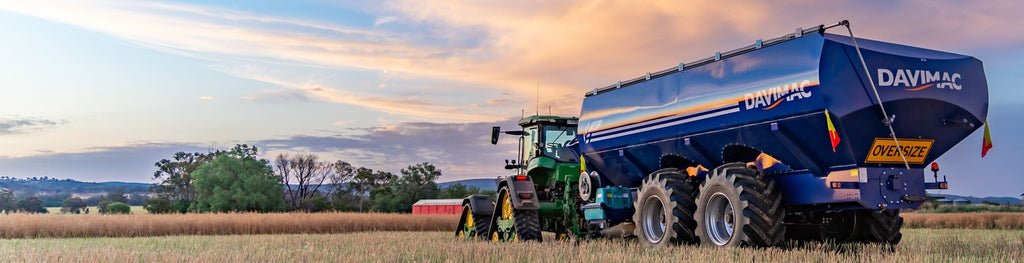

Chaser Bin Safety: The complete guide for harvest crews
Respect the auger, the weight and the hitch. The complete safety guide for harvest crews, drawn from the operator's manual and built for inductions.
Chaser Bin Safety: The complete guide for harvest crews
Chaser bin safety comes down to respecting three things: the auger, the weight, and the hitch. Almost every serious incident with a grain cart traces back to one of them, and every one is preventable with rules that cost nothing to follow. This guide collects the safety content from the Davimac operator's manual in one place for harvest crews and the people inducting them; it supports the manual for your specific machine, which is always available in the manual library, and the safety decals on the bin itself.
In this guide:
- Start with the paperwork that matters
- The auger: the hazard that outranks all others
- The weight: towing, braking and slopes
- On the public road
- The hitch: where people get caught
- Hydraulics and tyres: the quiet hazards
- Fire: the bin won't start one, but it will be standing next to one
- Safe maintenance and storage
- Build the risk assessment habit
- Induct the crew, not just the machine
- Quick answers
Start with the paperwork that matters
Two documents and a set of stickers. Every operator should read the operator's manual before their first shift, not their first breakdown; it is the operator's responsibility to know how to operate and service the machine. Safe Work Australia's code of practice on managing the risks of plant in the workplace, and SafeWork NSW's codes 'Equipment on Farms' and 'Get Grain Safe', are free to download and worth the hour, whichever state you farm in. And the safety decals on the bin are the short version of everything below: keep them clean, replace them when faded or damaged (replacements are available from Davimac), and never on-sell a machine without its full decal set.
The auger: the hazard that outranks all others
A grain auger moving a tonne every few seconds does not distinguish between grain and anything else. The rules are absolute. Never enter the bin unless every one of these conditions is met: the bin is on level ground, the park brake is on, the tractor is disabled, and the PTO shaft and hydraulic hoses are uncoupled. Never walk on top of the grain in the bin; grain behaves like liquid around a running auger and like quicksand around a blocked one. Never clear debris, inspect, or perform any maintenance on the auger system while it has power. And before raising the vertical auger, always look up: power lines, trees and shed roofs are all at auger height.
Around the outside of the machine, keep hands, feet and clothing away from power-driven parts, wear snug-fitting clothing that can't be caught, and keep everyone clear of the working area while the augers run. The PTO shaft guard must be in place, undamaged and spinning freely on the shaft, every day, no exceptions.
The weight: towing, braking and slopes
A loaded 35T chaser bin grosses around 49 tonnes, roughly three and a half times its empty weight, and it changes how everything behaves. The manual's numbers: 10 km/h maximum loaded, 30 km/h empty, lower again on farm tracks, verges and inclines. Confirm the tractor is rated to tow the fully loaded bin before harvest, not during it; the loaded weight of every model is in the manual's specifications. Brake in a straight line to avoid jackknifing, take extra care in mud, on inclines and through sharp bends, and don't turn so tightly the bin rides up on its own wheels. Fill the bin evenly so the hitch load neither lifts the tractor's rear nor slams down on it.
The safety chain is the last line: attach it to an anchor on the tractor capable of holding the full loaded bin, every hitch-up, and shorten it so a failed coupling can't drop the drawbar to the ground.
On the public road
Between paddocks, the chaser bin becomes an oversize vehicle among traffic that doesn't expect it, and the manual's caution is plain: towing agricultural machinery on public roads means complying with all relevant state authority road rules. Before the move: empty the bin where possible, fold and secure the auger, stow the jack in its transport position, close and lock the tarp, and confirm the road kit is working and visible, amber beacon, flags, LED tail lights and the oversize sign. Know your machine's transport width and what your state requires for it before you reach the gate. Then drive to the load, not the limit: lower speeds on verges and where a wheel runs off the seal, straight-line braking, and routes and timing that keep you off busy roads at harvest traffic hours. Ten minutes of route planning is cheaper than any conversation that starts with a car in the table drain.
The hitch: where people get caught
Hitching is the moment a person stands between two machines, which is why the manual treats it as a crushing hazard. Nobody stands between tractor and bin while the tractor moves; stop the engine and set the park brake before anyone installs the hitch pin. The same discipline applies to the jack stand (solid ground, properly stowed before moving off) and to anyone working around the machine: never dismount a moving tractor, never ride on the bin, and never carry passengers on the tractor.
Hydraulics and tyres: the quiet hazards
Hydraulic fluid under pressure can penetrate skin through a hole too small to see. Check suspected leaks with a piece of cardboard and heavy gloves, never a bare hand, relieve system pressure before disconnecting any line, and get immediate medical help if fluid does penetrate skin; it is a genuine emergency however small it looks.
Tyres at these sizes are their own hazard class. Inflate with a clip-on nozzle and an extension hose long enough to stand to one side of the assembly, never walk away mid-inflation, and leave wheel changes to trained people with wheel-handling equipment rated for the weight. Check pressures weekly against the inflation chart, and check wheel nut torque daily for the first three days after any wheel is fitted, then weekly; loose wheel nuts are one of the most common faults found on chaser bins in the field.
Fire: the bin won't start one, but it will be standing next to one
Chaser bins themselves are an unlikely ignition source, but harvest fires are not rare events: Kondinin Group research puts it at around 7 per cent of harvesters starting a fire in a given year, with roughly one in ten of those causing significant damage to the machine or the crop. The header is where it starts, and the chaser bin is the machine standing closest when it does, which makes the chaser driver the default first responder. That's the whole case for carrying firefighting equipment on the bin: Davimac offers a chassis-mounted 9 L air/water extinguisher for small fires, or a forward-mounted 400 L unit with pump and 36 m hose dispensing up to 120 litres a minute; we've compared the two in chaser bin firefighting options.
Equipment only counts if the response does. Every operator should know where the unit is, how to start the pump, and how to run the hose out before the day it matters, and the pre-season check should include filling the tank, running the pump and confirming the extinguisher is charged and in date. On days of elevated fire danger, park smart between loads (stubble under a hot machine is fuel), stay aware of wind direction, and know the paddock's exit points. GRDC's Reducing Harvest Fires back pocket guide is the reference worth keeping in the cab, and it's free to download.
Safe maintenance and storage
Maintenance safety is mostly setup: never work under or on a loaded bin, park on level ground, chock the wheels, disable the tractor and remove the key, make sure all moving parts have stopped and hydraulic pressure is relieved, and clear tools from the machine before it runs again. Adjusting wheel centres for controlled traffic deserves its own respect: the bin must be empty, on level concrete, jacked one side at a time, chocked, and held on proper supports, never on jacks alone. The full pre-season workover is in our pre-harvest maintenance checklist, and machine-specific procedures are in the manual library.
Build the risk assessment habit
The manual is blunt that no list of identified hazards is ever complete, and it puts a simple tool behind that: rate any task's probability and consequence, multiply them, and treat the result seriously. The discipline matters more than the arithmetic. Before any non-routine job (a blockage, a repair in the paddock, a wheel adjustment), stop long enough to ask what can go wrong, how badly, and what control makes it safe. Thirty seconds of that thinking is the cheapest safety equipment on the farm, and it's the habit that covers everything a checklist can't.
Induct the crew, not just the machine
Harvest crews turn over, and the chaser seat is where the newest people land. An induction worth the name covers the decals, the auger rules, the speed limits, the hitching procedure and the emergency stop, with the manual open and the machine in front of them. Our driver's guide to operating a chaser bin covers the working technique and makes a solid induction companion, and every Davimac in the chaser bin range carries the same decal set and safety systems, so training carries across the fleet.
Quick answers
When is it safe to enter a chaser bin?
Only when all of these are true: the bin is on level ground, the park brake is on, the tractor is disabled, and the PTO shaft and hydraulic hoses are uncoupled. Never enter while augers have power, and never walk on top of grain in the bin.
How fast can you safely tow a chaser bin?
Davimac operator manuals specify 10 km/h maximum when loaded and 30 km/h empty, with lower speeds on farm tracks, verges, inclines and in mud. Brake in a straight line to avoid jackknifing, and confirm the tractor is rated for the bin's full loaded weight.
What safety gear should a chaser bin operator use?
Snug-fitting clothing that can't catch in driven parts, hearing protection such as earmuffs or earplugs, and appropriate PPE for any maintenance task. Avoid radio or noise-cancelling headphones while operating; they remove the machine's audible warnings along with the noise.
Do chaser bins need a fire extinguisher?
Strongly recommended. Around 7 per cent of harvesters start a fire each year according to Kondinin Group research, and the chaser bin is usually the closest machine to the header when it happens. A chassis-mounted extinguisher handles small fires; a 400 L firefighting unit with pump and hose gives genuine first-response capability.