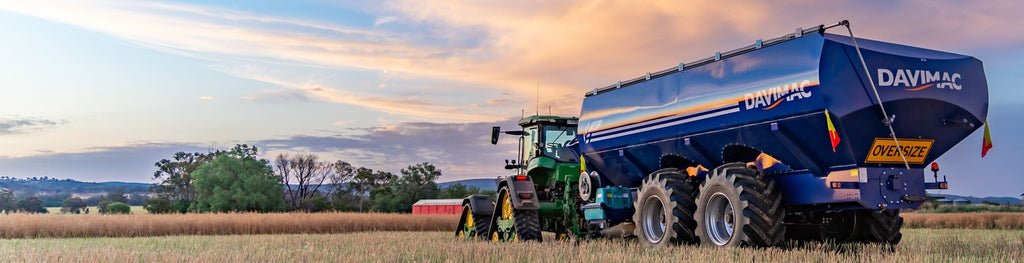

Chaser bins, mother bins and field bins: How harvest grain logistics fit together
Three bins, three different bottlenecks. How chaser bins, mother bins and field bins stack together, and how to name your constraint before buying steel.
Chaser bins, mother bins and field bins: How harvest grain logistics fit together
From header to home
Three kinds of bin are involved during an Australian harvest:
- The chaser bin follows the header and keeps it cutting
- The mother bin sits at the paddock's edge as a big transfer point between chasers and trucks
- The field bin stores grain on farm until it's convenient to move or sale price is more favourable.
Each solve three different bottlenecks, and the right combination depends on where your harvest actually loses time. Here's how each works and how they stack together.
In this guide:
- What does a chaser bin do?
- What is a mother bin and what does it do?
- What size mother bin do you need?
- What does a field bin do?
- Side by side
- How the combinations work
- Where to start
- Quick answers
What does a chaser bin do?
The chaser bin's primary job is header utilisation. It runs alongside the header, takes grain on the move, and carries it to the trucks so the header never stops with a full tank. Kondinin Group's chaser bin research describes them as the vital link between harvesters and the field bins or mother bins behind them, and puts the stakes plainly: any time a harvester sits idle with a full tank is time lost, and an extended harvest window risks post-maturity yield losses in the order of half a per cent a day.
Capacities in the Davimac chaser bin range run 25 to 45 tonnes. Matching that size to your header and trucks is covered in What size chaser bin do I need?.
What is a mother bin and what does it do?
A mother bin is a high-capacity transfer bin, typically in the range of 100 to 150 tonnes, sometimes larger. It is generally parked at the edge of the paddock or a central point between paddocks for chaser bins to unload into.
In turn, it can outload grain to a waiting semi through it's onboard auger. Mother bin augers are generally smaller than chaser bins as speed is not a primary issue. A mother bin stays put through the day's harvesting (shifted occasionally as the program moves between blocks) and works as the fixed point the whole grain chain pivots around. Mother bins are not designed to be moved while full, so their engineering and design are often not as heavy duty as a chaser bin which carts heavy loads frequently.

A mother bin is like a buffer or cache between the paddock side of harvest (i.e: header plus chaser) and the road side (i.e: trucks to the receival site or storage). Chasers keep cycling when no truck is home, so the header never waits on road logistics. Trucks load fast the moment they arrive, often in minutes through the mother bin's outload auger, so drivers spend their hours on the road rather than idling at a paddock gate. And because trucks load at the mother bin on firm access, road trucks stay off soft paddocks entirely, which protects both the truck and the field's soil.

Mother bins earn their keep when the carting leg is the bottleneck. Long lead distances to the receival site, limited trucks, harvest-hour queues at the ramp, or big programs where header capacity outruns road capacity every afternoon are all ideal circumstances to employ a mother bin.
They're a serious piece of capital and another machine to shift, so the case rests on how much header time truck delays currently cost you.
What size mother bin do you need?
Mother bin sizing logic mirrors that of a chaser bin. A mother bin needs to absorb what the paddock produces between truck visits, so the two numbers that matter are your daily harvest rate and your truck cycle time.
A program cutting 60 tonnes an hour with trucks on a three-hour round trip needs roughly 180 tonnes of buffer to never slow the header, which is why bigger programs run the top of the capacity range or pair a mother bin with field bins. A shorter truck cycle, or more trucks, shrinks the buffer you need.
The other check is fill compatibility with your chaser. The mother bin's fill height needs to sit under your chaser's discharge height and its capacity should hold a clean multiple of your chaser loads so the chaser never arrives to a bin with half a load of space. Under-sizing a spec is an expensive mistake. A mother bin that fills mid-afternoon just moves the queue from the ramp to the paddock edge.
What does a field bin do?
A field bin is on-farm buffer storage. A mobile bin, typically towed empty between sites, that holds grain until it's convenient to move or economically advantageous to sell when the grain price is more favourable (often during winter).

Where the mother bin is a live transfer point working during harvest hours, the field bin is patience: it lets you keep harvesting when the receival site is shut or queued, hold grain to segregate varieties or grades, or wait out a price rather than selling off the header. Filling and emptying is slower than a mother bin's transfer rate, which is fine, because its job is storage rather than throughput.
Side by side
| Chaser bin | Mother bin | Field bin | |
|---|---|---|---|
| Job | Keep the header cutting | Decouple paddock from road | Buffer storage on farm |
| Typical capacity | 25 to 45 t | 100 to 150 t | Varies widely |
| Moves during harvest | Constantly, in paddock | Occasionally, between setups | Rarely; parked |
| Fills from | Header, on the move | Chaser bins | Chaser bins or augers |
| Empties into | Trucks or mother bin | Trucks, fast | Trucks, when it suits |
| Solves | Header idle time | Truck cycle and ramp queues | Receival limits, segregation, timing |
How the combinations work
Header plus chaser plus trucks is the baseline system, and for operations with short lead distances and enough trucks, it's the whole answer. A chaser alone recovers the header idle time, which is where the biggest single gain lives. Add a mother bin when trucks can't keep pace with the paddock. When the chaser's cycle shortens (it's unloading at the fence line, not waiting for a truck), then the trucks' cycle shortens too. Add field bins when the constraint is beyond the farm gate (receival hours, segregation, or marketing timing).

Where to start
For most operations the sequence is the one above: get the chaser right first, because header idle time is the most expensive minute in the system, then let the truck data tell you whether a mother bin or field bins come next. If the chaser is the current question, the chaser bin buyer's guide works through the whole decision, and the dual axle chaser bins carry the capacities that pair with mother bin systems.
Quick answers
What is the difference between a chaser bin and a mother bin?
A chaser bin (25 to 45 tonnes) follows the header in the paddock and keeps it harvesting. A mother bin (typically 100 to 150 tonnes) sits at the paddock edge as a transfer point: chasers unload into it and trucks load out of it, so the paddock and the road sides of harvest stop waiting on each other.
Do I need a mother bin?
Only if trucks are your bottleneck. If chasers regularly wait for trucks, lead distances are long, or the header outruns road capacity each day, a mother bin decouples the two and recovers that time. If the header rarely waits, the money does more work in chaser capacity or trucks.
What size mother bin do I need?
Size it to absorb what the paddock produces between truck visits: daily harvest rate multiplied by truck cycle time sets the buffer. It should also hold a clean multiple of your chaser bin loads, and its fill height needs to sit under your chaser's discharge height.
What is a field bin used for?
On-farm buffer storage. Field bins hold grain when the receival site is closed or queued, allow segregation of varieties or grades, and give the option of holding grain for marketing reasons rather than selling everything off the header at harvest prices.