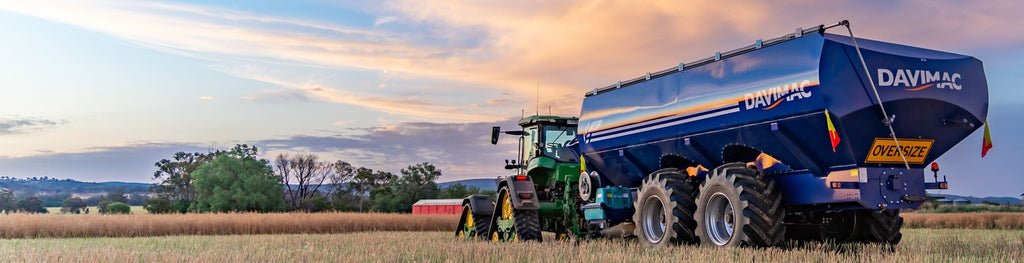

The Davimac 45T chaser bin has arrived: who it suits and how to spec one
The 45T is here. 45 tonnes, standard rear steering, optional brakes. Learn what's new, how it fits alongside the rest of the range, and the practical details worth knowing before you spec one.
The Davimac 45T chaser bin has arrived: who it suits and how to spec one
Our biggest chaser bin is now available nationally. The 45T is a 45-tonne dual axle model built for operations running high-output headers, and it's the direct result of what growers have been telling us for years: give us more capacity, put a steering axle under it, and give us the option of brakes.
This post covers what's new on the 45T, how it fits alongside the rest of the range, and the practical details worth knowing before you spec one. If you're starting from scratch on chaser bins generally, our chaser bin range overview is the better place to begin.
Why we built a 45-tonne bin
Header capacity has grown faster than most grain logistics setups. When the front can cut quicker than the bin and trucks can clear it, the header waits, and every minute it sits idle at full yield is grain still standing in a weather-shortened window. A larger buffer between header and truck keeps the front moving, which is the whole job of a chaser bin.
But capacity alone was never the brief. A 45-tonne payload on the wrong undercarriage compacts soil, fights the tractor on every headland turn and wears running gear early. The engineering under the bin mattered as much as the volume inside it.
What's different about the 45T
The 45T runs a dual axle undercarriage with rear self-steering fitted as standard. The steering axle lets the bin track behind the tractor rather than dragging across the turn, which cuts wheel scuff on headlands and spreads ground pressure across the paddock.
Unloading runs through a 24-inch auger rated to shift up to 18 tonnes of grain a minute, keeping truck turnaround short when harvest is at full pace. A bin that fills quickly but empties slowly just moves the queue from the header to the truck.
Hydraulic brakes are available as an option, fitted to stronger 12-stud axles rather than the weaker 10-stud arrangement that's standard across much of the industry. As far as we're aware, we're the only Australian manufacturer running brakes on a 12-stud axle. For a loaded bin of this size, brakes are worth serious consideration, particularly on undulating country or where the bin regularly crosses roads between paddocks.
Beyond that, the 45T is deliberately familiar. It carries the same fully welded construction, easy cleanout, large gearbox and heavy-duty undercarriage as the rest of the range. Full dimensions and model-by-model specs are on our specifications page.
Is the 45T the right size for your operation?
The honest answer is: Not always. The 45T earns its keep where header output is genuinely outrunning grain logistics: large programs, high-capacity fronts, long carts to the truck or mother bin. If your header rarely waits on the bin, extra capacity is money spent on a problem you don't have.
Our 30T and 35T bins remain the pick for most mid-to-large-sized operations. They strike the balance between capacity and ease of handling, and they have one of the lowest load heights on the market, which helps header drivers avoid collisions and keeps the centre of gravity down for a more stable ride.
For contractors, the 35T bin hits the sweet spot for capacity vs ease of transport logistics between jobs (no escort required). It also has the added advantage of being able to be switched on-site to suit CTF setups. Smaller programs, or operations working tighter paddocks and gateways, are often better served by a single axle chaser bin.
How to determine chaser bin size
A rough rule of thumb is your bin should hold at least two full header tanks, and ideally three, so the header never sits with a full tank waiting on the bin.
For a class 8 header that maths usually lands at 25 to 30 tonnes; a class 9 or 10 front, two headers, or long carts to the truck are what push the answer to 35 tonnes and beyond. Cart distance and truck cycle times matter as much as tank size: a 45T behind a single mid-sized header is capacity you've paid for and won't fill, while the same bin behind two big fronts on a long run to the road earns its keep every rotation.
Options and setup: what to think about
Like every Davimac bin, the 45T can be optioned to suit the operation. The ones worth weighing up at order time:
- Load cells with Libra Cart give you live weights as you fill, which keeps truck loads legal and takes the guesswork out of splitting loads at the silo.
- Camera kits improve visibility around a machine of this size, particularly when reversing or working alongside the header at night. We think this is a must.
- Fire-fighting units are cheap insurance in a hot harvest.
- Right-hand auger discharge is a personal preference, and can suit operations where paddock layout or truck positioning makes a left-side unload awkward.
- A custom paint and decal finish will make the bins colour-match your tractor and header fleet.
Many of the options provided by Davimac can be retrofitted after purchase, with the exception of auger discharge side and bin colour which must be factory built-in.
Living with a 45T: setup and maintenance
Operators moving up from a smaller Davimac will find the routine familiar. The fully welded body means there's no bolt-checking regime on the bin itself, and cleanout is the same straightforward job as the rest of the range, which matters when you're switching between grades or crops mid-harvest.
Pre-season, the checklist is the usual discipline: grease the driveline and auger pivots, check gearbox oil, inspect tyre pressures against your load and soil conditions, and run the tarp and auger through their full travel before the header rolls. If you've optioned hydraulic brakes, bleed and test them under load before harvest, not during it. Your dealer can run through the full pre-delivery and first-service schedule when the bin lands.
Availability
The 45T is available now through Davimac's national dealer network, with parts, servicing and advice handled locally.
Thinking about owning one? Configure and price your own 45T chaser bin today.