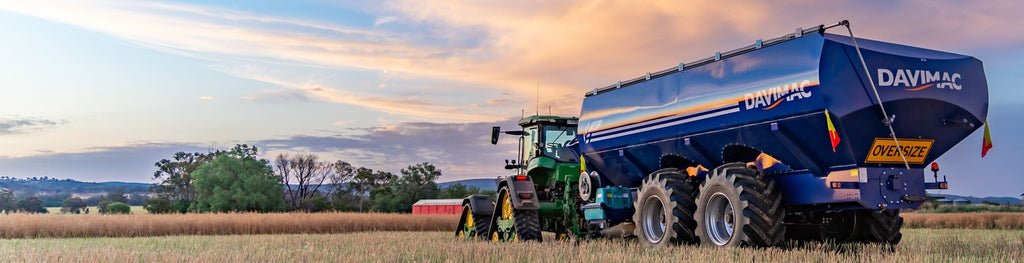

Single axle vs dual axle chaser bins: which one suits your operation?
Single axle vs dual axle chaser bins: which one suits your operation?
Inside this article:
- What's the difference?
- Total load capacity
- Compaction and flotation
- Manoeuvrability: turning and headland access
- Towing, weight and simplicity
- Not all dual axles are built the same
- The 30 tonne question
- What the 45T adds
- Side by side
- Which one should you buy?
Single axle chaser bins are lighter, simpler and cheaper, and suit 25 to 30 tonne capacities on firm country. Dual axle bins spread the load across four tyres on a walking beam undercarriage, which means less soil compaction, smoother towing and capacity up to 45 tonnes. The right answer depends on your soils, your header, your paddock layout and how hard the bin will work. Here's how the two configurations actually differ.
What's the difference?
A single axle bin carries the load on one axle and two tyres. A dual axle (tandem) bin runs two axles and four tyres, connected by a floating walking beam: a centre-pivoting beam that lets the axle pair rock over uneven ground so all four tyres stay loaded and following the surface, rather than see-sawing weight between them.
That one structural difference drives everything else: how much the bin can carry, how it treads on soil, how it turns and tows, and what it costs.

Total load capacity
In the Davimac range, single axle bins come in 25T and 30T, and dual axle bins in 30T, 35T and 45T. That split isn't marketing; it's physics. A single axle carrying 30 tonnes of grain plus the bin is at the practical limit of what two tyres should put through one footprint. Above that, the load needs spreading, which is what the tandem undercarriage does: Davimac dual axle models run an 80 tonne axle rating against 40 tonnes for the single.
The axle rating isn't the whole picture, though. Both the axle and the tyres fitted to your chaser bin carry the full weight of the machine and its load, nearly 18 tonnes of empty bin alone on a 45T model before any grain goes in, and whichever rating is lower sets the real ceiling on what you can safely carry. Nor is that the whole load path: a share of the total also rests on the tractor drawbar as tongue weight, up to 4,800 kg depending on model, which is why the tractor's tow rating has to be matched to the bin too. Per-model tongue weights are on the specifications page.
The numbers make the case. A fully loaded 30T single axle weighs around 40 tonnes all up. With 4,800 kg of that on the drawbar, each of its two tyres carries roughly 17,650 kg; the standard 900/60-32 fitment is rated for 20,757 kg per tyre in cyclic service at 10 km/h, and the 40 tonne axle rating covers the same load with room to spare, so the configuration works because axle, tyres and drawbar are all designed around the one figure. Put the same load on a dual axle bin and each tyre carries closer to 9,550 kg, roughly half. That headroom is what the tandem buys you.

Compaction and flotation
Four tyres put roughly half the weight through each contact patch that two tyres would, and the walking beam keeps all four evenly loaded instead of letting one pair spike as the bin rocks. On heavy soils, wet-prone country or anywhere you're managing compaction seriously, that's the strongest argument for the dual axle, and it compounds over every pass of every harvest.
Both configurations take high-flotation tyres as an option for softer ground, and 25T to 35T models run wheel centres adjustable from 2.56 m out to 3.0 m to match controlled traffic systems. If compaction is the deciding issue for you, tyre choice matters as much as axle count; how tyre width, tread and construction affect ground pressure is covered in our chaser bin tyre guide.
Manoeuvrability: turning and headland access
This is where the single axle earns its keep in a way that doesn't show up on a spec sheet. A single axle bin pivots around one point directly under the bin, so it turns the way a normal trailer does: tight, predictable, and following the tractor's line. A tandem axle set doesn't behave the same way. Two fixed axles resist turning, because the rear axle wants to track a different arc to the front one, which shows up as tyre scrub, extra drag through the corner and a wider effective turning circle.

Davimac's engineering answer to this is the self-steering rear axle, standard on the 45T, which lets the back axle track through the turn instead of scrubbing, cutting turning resistance and soil disturbance. It's a genuine fix, but it's also proof of the trade-off: a tandem bin needs added engineering to turn as cleanly as a single axle does by default. Davimac 30T and 35T duals don't have a self-steering axle as standard to allow for the user-adjustable wheel centres (important for contractors frequently moving on and off road transport trucks between jobs but need to have CTF compatibility), so on tight headlands, laneways or shed access, a single axle bin will generally out-manoeuvre a standard tandem of similar capacity.
For operations with tight paddock geometry, narrow gateways or a lot of headland turning relative to bin capacity, that's worth weighing against the compaction and capacity advantages of the tandem. It's one more reason the 30T, built in both configurations, is genuinely an even contest rather than an obvious upgrade path.
Towing, weight and simplicity
The single axle's other advantages are straightforward. Less steel means less tare weight to drag around all harvest: a 30T single axle weighs 10,000 kg empty against 13,000 kg for the 30T dual. Fewer wearing parts means less to maintain, and a shorter, lighter package is easier to store and shift between blocks. On firm ground behind a mid-sized tractor, a single axle bin is the simpler machine doing the same job. Full weights, tongue loads and tractor requirements per model are on the specifications page.
Not all dual axles are built the same
Spring vs Walking Beam
Once you've settled on a tandem, look hard at what kind of tandem it is, because the industry builds them two very different ways. Some manufacturers use undercarriages adapted from lighter, cheaper road running gear: glorified truck axles on leaf spring packs, with shackles, bushes and hangers between the load and the chassis. Others, like the walking beam, are purpose-built for paddock work: a single greased pivot, no springs, and the load path running straight through heavy steel.
The difference shows up in years three to ten. A paddock is not a highway. Chaser bin axles cop shock loading off contour banks and washouts, side loads through tight turns at full weight, and dust and chaff in every moving part, all in 40 degree heat. Spring packs, shackles and bushes are wearing parts under those conditions; each one is something to inspect, something that sags, and something that can let go mid-harvest. A walking beam has one job and one pivot point doing it.

To be fair to sprung designs, leaf springs ride softer on bitumen, and often provide a cheaper entry into features such as steering axles and brakes, and if your bin spends serious time on the road between blocks that's something to think about.
But the bin earns its #1 keep in the paddock, and paddock reliability is a function of simplicity. Independent industry assessment leans the same way: Kondinin Group's January 2025 chaser bin research report notes that nearly every 30 tonne-plus bin runs a tandem or triple axle, and that walking beam configurations are a popular choice for keeping tyres in contact with the ground through rough country.
Wheel Hub Stud Count
Wheel hub stud count is another detail worth checking and easy to overlook. Many chaser bins on the market run a 10-stud hub, which is a lighter-duty fitment carried over from smaller trailer and implement axles, and it's a recognised weak point under repeated full-load harvest conditions, with cracking and stud failure a known risk. Davimac runs a 12-stud hub axle as standard across the range, single and dual axle alike, built for the load cycling and lateral forces a fully loaded bin actually sees rather than a lighter-duty rating.

Be sure to compare apple with apples
When comparing manufacturers, and on-paper specs, make sure you're comparing apples with apples, not just numbers and features on a sheet. Steering axle or brakes count for little if they're bolted to a weaker, less reliable undercarriage; the feature list doesn't tell you whether the bin under it will still be working in year five. A walking beam pivot and a leaf spring pack both tick the box marked "tandem axle", and a 10-stud hub and a 12-stud hub both tick "heavy duty", but they're not the same steel doing the same job.
So whatever brand you're weighing up, ask the same questions: what is the axle rating against the bin's loaded weight, what stud count is the hub, which undercarriage components are wearing parts, and what would a mid-harvest failure cost me? You might be surprised with the answer.
The 30 tonne question
Davimac builds the 30T in both configurations, and the choice between them is the whole decision in miniature. Same capacity, same auger, same bin. Pick the dual if your ground is heavy, wet-prone or under CTF, and the 3,000 kg of extra undercarriage buys you flotation and ride. Pick the single if your country is firm, your paddocks favour tighter turning, and you'd rather put the price difference into options like scales, or into the fuel the lighter bin saves. Neither is wrong; they're built for different paddocks.
What the 45T adds
At 45 tonnes, the dual axle undercarriage picks up two extras. A self-steering rear axle lets the back axle track through turns instead of scrubbing sideways, which cuts turning resistance and soil disturbance with a machine this size, and locks hydraulically for reversing; Kondinin Group's research rates steerable axles an asset for exactly those reasons. Hydraulic disc brakes are available on the leading axle for control on hills and road moves. The 45T also runs fixed 3.0 m wheel centres to suit CTF as standard.

Side by side
| Single axle | Dual axle | |
|---|---|---|
| Capacities | 25T, 30T | 30T, 35T, 45T |
| Tyres on the ground | 2 | 4 (walking beam) |
| Hub stud count | 12-stud | 12-stud |
| Axle rating | 40 tonnes | 80 tonnes |
| Empty weight (30T) | 10,000 kg | 13,000 kg |
| Compaction | Higher per tyre | Load spread, evenly followed |
| Turning circle | Tighter, single pivot | Wider, mitigated with rear-steering |
| Ride on rough ground | Good | Better (beam follows terrain) |
| Maintenance | Simplest | More components |
| Relative price | Lower | Higher |
| Best suited to | Firm country, tighter paddocks, class 7 to 8 headers | Heavy or wet-prone soils, CTF, class 9+ or multi-header |
Which one should you buy?
Start from your soils, your header and your paddock layout, not the price list. Firm ground, tighter turning or a single header up to class 8: the single axle range does everything you need. Heavy country, controlled traffic, class 9 and up, or two headers: the dual axle range earns its price difference every wet spring. If you're still weighing capacity itself, work through what size chaser bin you need first, or take the full decision step by step in our chaser bin buyer's guide.